

 English
 中文简体
中文简体
Author: Jie Chuang
Date: Aug 07, 2026
Do Stronger Glue Sticks Require Higher Temperatures
Many users assume that stronger adhesive automatically requires a hotter glue gun. The idea sounds logical—higher heat melts the adhesive faster, so the bond should become stronger. Reality is more complex. Bond strength depends on adhesive chemistry, open time, viscosity, substrate compatibility, and application technique rather than temperature alone.
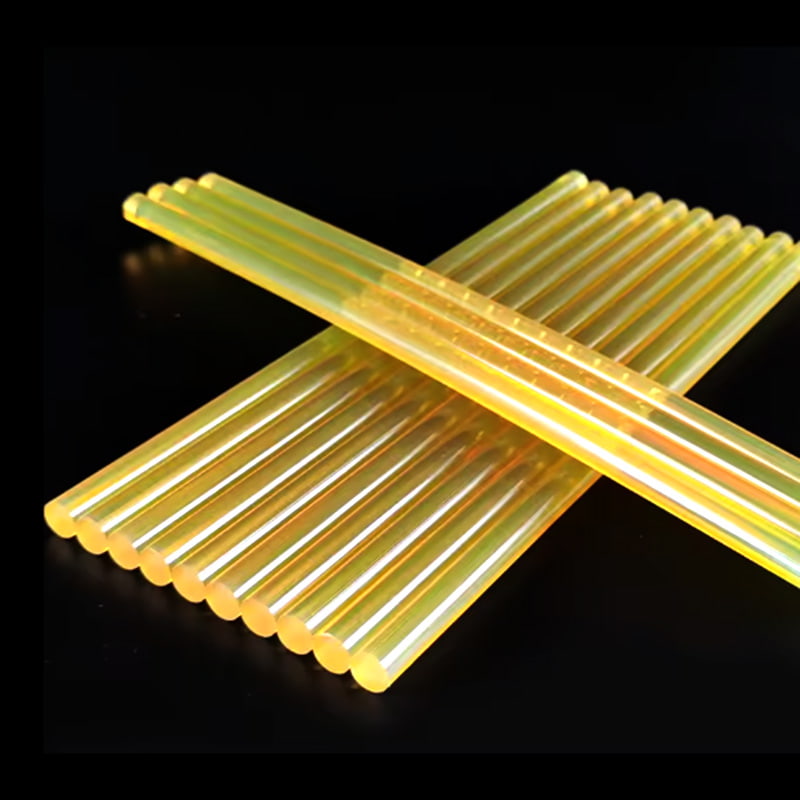
Modern high strength hot glue sticks are engineered with different polymer systems, allowing some products to deliver excellent holding power at standard operating temperatures, while others are designed specifically for high-temperature applications. Understanding this relationship helps users choose suitable materials instead of simply increasing heat. Manufacturer technical data also shows that application temperature varies considerably between formulations rather than following one universal standard.
Temperature and Bond Strength Are Not the Same Thing
Heat allows the adhesive to melt and flow across the substrate. Strength develops after cooling, as the polymer solidifies and forms a mechanical and chemical connection with the surface.
Several characteristics contribute to overall performance:
- Polymer composition
- Viscosity during application
- Surface wetting ability
- Cooling rate
- Flexibility after curing
A glue stick formulated with advanced polymers may create a stronger joint than another product operating at a higher temperature.
Typical Operating Temperature Ranges
Industrial and DIY glue sticks are available in several temperature categories.
| Glue Type | Typical Operating Temperature | Common Applications |
| Low Temperature | 120–150°C | Foam, fabric, paper crafts |
| Standard Temperature | 160–190°C | Wood, cardboard, plastics |
| Industrial High Temperature | 175–200°C | Metal, engineering plastics, demanding assemblies |
| Polyamide High Strength | 180–200°C (approx.) | Automotive, repair, industrial bonding |
Technical data sheets from multiple manufacturers show that ordinary EVA glue sticks often operate around 160–190°C, while certain industrial polyamide formulations recommend approximately 180–200°C. The higher setting supports proper flow characteristics rather than acting as the sole reason for greater bond strength.
Different Adhesive Chemistries Behave Differently
Glue sticks are manufactured from various polymer systems.
EVA-Based Adhesives
EVA remains one of the widely used materials for general-purpose hot melt products. It provides fast setting speed and works well across wood, cardboard, paper, and many plastics.
Polyamide Adhesives
Polyamide formulations commonly found in high strength hot glue sticks offer improved heat resistance, mechanical strength, and durability. These products frequently operate at relatively higher temperatures because the polymer itself requires additional heat to achieve proper viscosity.
Specialty Formulations
Some industrial adhesives combine modified polymers and tackifying resins to balance flexibility, impact resistance, and thermal stability without dramatically increasing application temperature.
Higher Temperature Also Has Trade-Offs
Increasing the glue gun temperature does not automatically improve every project.
| Potential Benefit | Possible Limitation |
| Better flow | Greater risk of material distortion |
| Longer open time | Extended cooling period |
| Improved surface wetting | Higher energy consumption |
| Suitable for dense materials | Not appropriate for heat-sensitive substrates |
Foam, thin plastics, decorative films, and lightweight fabrics may soften or deform under excessive application temperatures. Low-temperature glue systems were developed specifically to reduce this risk.
Surface Type Often Matters More Than Temperature
Material compatibility frequently has a greater influence on bond quality than simply increasing heat.
- Wood absorbs molten adhesive effectively.
- Steel benefits from improved surface wetting.
- Glass relies heavily on adhesive formulation.
- ABS generally bonds better than polyethylene.
- Polypropylene often requires specialty adhesives.
Using a hotter glue gun cannot completely overcome poor compatibility between adhesive chemistry and substrate surface energy.
Application Technique Still Influences Results
Even premium adhesive cannot compensate for poor application practices.
Helpful recommendations
- Keep bonding surfaces clean and dry.
- Allow the glue gun to reach its intended operating temperature.
- Apply steady pressure while assembling parts.
- Avoid excessive adhesive thickness.
- Allow sufficient cooling before loading the joint.
Manufacturer specifications commonly indicate an initial fixture time of approximately 20–60 seconds, while full bond development may continue during the following hour depending on adhesive formulation.
Common Technical Specifications
| Parameter | Typical Value |
| Stick Diameter | 7 mm / 11 mm / 12 mm |
| Softening Point | 75–90°C |
| Application Temperature | 120–200°C |
| Working Time | 20–60 seconds |
| Service Temperature | -20°C to +65°C (varies by product) |
These figures differ among manufacturers, making product data sheets an important reference before matching glue sticks with a particular glue gun or application.
Matching Glue Gun and Adhesive
Glue guns are generally available as low-temperature, high-temperature, or dual-temperature models. A glue stick designed for one operating range may not perform properly in another tool. Technical guidance from manufacturers advises using compatible glue sticks to maintain proper flow and avoid performance issues.
Greater bonding capability does not automatically require dramatically higher operating temperatures. The performance of high strength hot glue sticks comes primarily from their formulation, while temperature ensures the adhesive reaches the proper viscosity for application. Evaluating polymer type, substrate compatibility, working environment, and glue gun specifications together provides a more reliable approach than focusing on heat alone. Proper material matching often contributes more to bond durability than simply turning the temperature setting higher.