

 English
 中文简体
中文简体
Author: Jie Chuang
Date: Jun 05, 2026
Is High Viscosity Hot Melt Causing Stringing Issues
High Viscosity Hot Melt Adhesive is widely used in packaging, woodworking, automotive assembly, and industrial bonding due to its strong tack and gap-filling performance. However, one recurring production problem is stringing, also known as “angel hair,” where fine glue threads remain between the nozzle and the substrate during application. This issue is often misdiagnosed as equipment failure, while the real cause is frequently a combination of adhesive rheology and operational settings.
High Viscosity Hot Melt and Stringing Behavior
High viscosity means the adhesive resists flow and maintains internal cohesion even under heat. While this helps bonding strength, it also increases the risk of filament formation during nozzle cut-off.
Key mechanism behind stringing:
- Adhesive does not fully “snap” at nozzle exit
- Melted polymer chains stretch instead of breaking cleanly
- Residual tension pulls material into thin threads
Industry data confirms viscosity imbalance is one of the core contributors to stringing, especially when temperature control is unstable or nozzle conditions are not optimized.
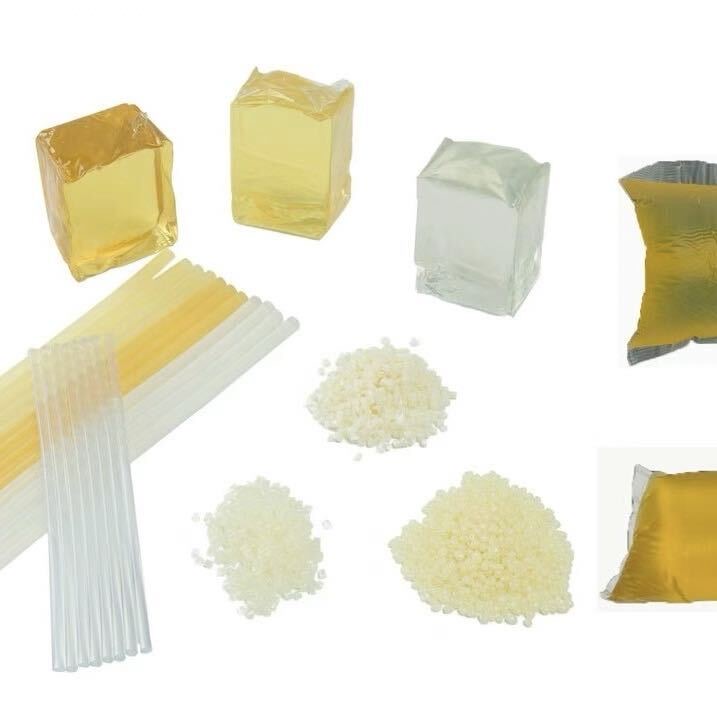
Direct Link Between High Viscosity and Stringing
High viscosity hot melt adhesive can increase stringing probability under several production conditions:
- Melt resistance becomes too high for clean separation
- Nozzle cut-off force is insufficient
- Adhesive cools slightly during travel, increasing effective viscosity further
- Elastic recovery of polymer chains pulls adhesive into filament form
At a molecular level, high molecular weight polymers increase viscosity and chain entanglement, which directly strengthens the “string effect” during break-off .
Operation Mistakes That Amplify the Problem
Many stringing complaints are not caused by the adhesive alone, but by incorrect processing conditions that exaggerate high viscosity behavior.
1. Low Application Temperature
- Temperature drop increases viscosity sharply
- Adhesive becomes too thick to cut cleanly
- Leads to long trailing threads after dispensing
Even a small deviation (5–10°C below recommended range) can noticeably worsen stringing.
2. Excessive Nozzle Distance
- Longer air travel allows cooling mid-air
- Adhesive partially solidifies before cut-off
- Threading becomes more visible and longer
3. Poor Cut-Off Pressure or Valve Timing
- Incomplete shut-off leaves residual adhesive
- High viscosity material continues stretching after stop signal
- Creates continuous “webbing” between cycles
Technical Parameters of High Viscosity Hot Melt Adhesive
Typical industrial specifications:
- Operating temperature: 160°C – 190°C
- Viscosity range: 8,000 – 25,000 mPa·s (at 180°C)
- Open time: 5 – 20 seconds depending on formulation
- Set time: 1 – 3 seconds for fast bonding lines
- Softening point: 85°C – 120°C
Higher viscosity grades generally provide stronger initial tack but require tighter control of application conditions.
Practical Causes of Stringing in Production Lines
High viscosity hot melt adhesive often exposes weaknesses in system setup:
- Nozzle wear or partial blockage increases drag
- Inconsistent heating zones create viscosity fluctuation
- Airflow from fans or HVAC cools adhesive too quickly
- Substrate temperature too low increases premature thickening
Stringing becomes more severe when multiple small deviations occur simultaneously.
Engineering Solutions to Reduce Stringing
Production stability can be significantly improved through controlled adjustments rather than changing adhesive grade immediately.
Temperature Stabilization
- Maintain consistent tank, hose, and nozzle heating
- Avoid overheating that causes polymer degradation
Optimized Nozzle Design
- Shorter nozzle distance reduces filament formation
- Anti-drip or shut-off nozzles improve cut-off precision
Pressure and Timing Calibration
- Increase solenoid response speed for cleaner cut-off
- Balance pressure to avoid over-extrusion
Environment Control
- Reduce direct airflow across application zone
- Stabilize workshop temperature to avoid viscosity drift
Key Insight: High Viscosity Is Not the Only Problem
High Viscosity Hot Melt Adhesive is not inherently defective. Stringing occurs most often when:
- Viscosity is high
- Temperature is slightly low
- Cut-off system is not optimized
This combination prevents the adhesive from breaking cleanly, leading to visible “angel hair” on production lines.
High viscosity improves bonding strength and heat resistance, but also increases sensitivity to application conditions. Stringing issues are not simply a material flaw; they are a system-level mismatch between adhesive rheology and process control.
Stable results depend on balancing viscosity with temperature precision, nozzle configuration, and cut-off performance. Once these factors are aligned, high viscosity hot melt adhesive can operate with clean dispensing and minimal stringing, even in high-speed production environments.