

 English
 中文简体
Author: Jie Chuang
Date: Oct 14, 2026
Does Hot Melt Adhesive Sheet Thickness Affect Bond Flexibility
Flexible materials can become noticeably stiffer after lamination, even though the bonding process appears successful. Fabrics may lose some of their stretch, foam composites may feel firmer, and layered components may resist bending more than expected. These changes can be related to adhesive chemistry, application temperature, bonding pressure, and the thickness of the adhesive layer.
At Zhejiang Jiechuang New Materials Technology Co., Ltd., we understand that adhesive performance involves more than holding two materials together. Customers working with textiles, footwear materials, foam, and composite components also need to consider flexibility, surface appearance, and the feel of the finished product. Thickness is an important variable in this evaluation, particularly for applications that require repeated bending or deformation.
A hot melt adhesive sheet provides a preformed adhesive layer that can be activated through heat and pressure. Its thickness influences the amount of adhesive available at the interface and can affect the behavior of the bonded structure. However, increasing thickness does not automatically improve bonding, and reducing it does not guarantee greater flexibility. The result depends on the adhesive formulation, substrate construction, and processing conditions.
1. How Does Adhesive Sheet Thickness Influence Flexibility?
Adhesive sheet thickness determines how much adhesive material is introduced between two substrates before activation. After heating and pressing, the adhesive may soften, flow, and conform to the contacting surfaces. The resulting bond line depends on the original sheet thickness, applied pressure, material porosity, surface texture, and the adhesive's flow characteristics.
A thicker adhesive layer can contribute more material to the interface, helping accommodate certain surface irregularities. At the same time, it may increase the proportion of adhesive within the finished composite and change how the assembly bends.
Three Common Thickness Effects
- Bending resistance: A thicker or relatively stiff adhesive layer may increase the force required to bend a laminated structure, particularly when the adhesive occupies a substantial portion of the composite.
- Surface conformity: Additional adhesive material may help accommodate uneven or textured surfaces, provided that the formulation can flow and wet the substrates adequately.
- Bond continuity: A thinner sheet contains less adhesive material. An insufficient amount may leave poorly bonded areas, especially across rough or porous substrates.
These effects are not universal. A soft, elastomeric adhesive film may preserve flexibility at a greater thickness than a relatively stiff film of the same dimensions. We therefore recommend evaluating thickness alongside the adhesive's mechanical properties instead of treating thickness as an independent indicator of flexibility.
2. Adhesive Sheet Thickness and Bond-Line Thickness Are Different
Understanding the difference between the supplied sheet and the finished adhesive layer helps explain why thickness specifications need careful interpretation.
| Parameter | Meaning | Why It Matters |
| Sheet thickness | Thickness of the adhesive sheet before bonding | Determines the initial amount of adhesive material introduced into the assembly |
| Bond-line thickness | Thickness of the adhesive remaining between substrates after bonding | Influences interface geometry, stress distribution, and composite behavior |
| Applied pressure | Pressure exerted during heat activation and joining | Affects adhesive flow, substrate contact, and the final layer geometry |
| Adhesive coverage | Extent to which the intended bonding area receives adhesive | Helps determine whether the joint contains unbonded regions |
A sheet measuring 0.10 mm before processing does not necessarily produce a finished bond line of exactly 0.10 mm. The actual result depends on the material system and pressing conditions. Excessive pressure may push softened adhesive away from the intended area, while insufficient pressure may prevent adequate contact.
At Jiechuang, we encourage customers to define the thickness requirement according to the actual bonding process. A purchasing specification should distinguish the incoming sheet dimension from the thickness and coverage required in the finished assembly.
3. Does a Thicker Hot Melt Adhesive Sheet Make Materials Less Flexible?
A thicker adhesive sheet can increase the stiffness of some laminated structures, but the outcome depends on the relative properties of the adhesive and the substrates. Material stiffness, layer arrangement, and the location of the adhesive within the composite all influence bending behavior.
Applications That Require a Soft Feel
Textiles, elastic fabrics, and lightweight laminates often need to retain their original drape or stretch. An adhesive layer that is too stiff or too extensive may create a noticeable change in hand feel.
- Apparel and textile lamination: The adhesive should provide adequate attachment without unnecessarily restricting fabric movement.
- Elastic materials: Bonding should be evaluated under extension and recovery cycles rather than through a static strength test alone.
- Foam composites: The adhesive layer should maintain contact while accommodating the compression and deformation expected during use.
- Flexible accessories: Bending performance and surface appearance may be as important as the force required to separate the bonded materials.
A flexible adhesive formulation can accommodate movement more readily than a rigid formulation under comparable conditions. However, a thick flexible layer can still change the feel of a lightweight substrate, while a thin layer may fail to provide adequate coverage. The target should be a suitable combination of material properties and adhesive quantity.
4. How Does Thickness Affect Bond Strength and Surface Contact?
Flexibility cannot be evaluated separately from adhesion. A material may remain soft after bonding yet fail to maintain adequate contact across the interface. Conversely, a strong bond may create a composite that is too rigid for its intended use.
Thickness influences the available adhesive volume, but bond strength also depends on wetting, surface energy, material compatibility, and the quality of the heat-pressing process.
Thin Adhesive Sheets
- Can help limit the amount of adhesive introduced into lightweight assemblies.
- May preserve the original surface profile and reduce a noticeable adhesive layer.
- Require sufficient coverage to prevent unbonded areas or adhesive starvation.
- May be less suitable for substrates with pronounced surface irregularities, depending on their flow behavior.
Thicker Adhesive Sheets
- Provide a larger initial volume of adhesive material.
- May help accommodate some textured or uneven surfaces.
- Can change the stiffness and thickness of the finished laminate.
- Require appropriate heating and pressing conditions to achieve consistent contact throughout the bond area.
Research on adhesive bonding also shows that the relationship between layer thickness and joint strength varies with adhesive chemistry and joint design. Results from rigid structural adhesives should not be transferred directly to flexible hot melt films. Each material system needs testing under its intended conditions.
5. Which Processing Parameters Affect the Final Bond?
Even a correctly specified adhesive sheet can produce inconsistent results if the heat-pressing process does not match its technical requirements. Temperature, pressure, dwell time, and cooling conditions all influence the final adhesive layer.
| Processing parameter | Potential effect | Recommended check |
| Activation temperature | Controls adhesive softening and flow | Follow the product's recommended processing range |
| Pressing pressure | Affects surface contact and adhesive displacement | Check coverage and thickness after bonding |
| Dwell time | Influences heat transfer and adhesive activation | Confirm that the complete bonding area receives sufficient heat |
| Cooling conditions | Influence solidification and handling behavior | Maintain consistent cooling before evaluating the joint |
| Substrate thickness | Affects heat transfer and the behavior of the composite | Test the actual material stack rather than isolated layers |
Temperature deserves particular attention. Insufficient heat may prevent the adhesive from wetting the substrate adequately, while excessive heat can damage sensitive materials or alter their surface appearance. The appropriate setting depends on the adhesive formulation and the heat tolerance of the bonded materials.
Pressing pressure also needs to be controlled. Excessive pressure may displace softened adhesive from parts of the joint, while insufficient pressure can leave air gaps or poor surface contact. Consistent conditions make it easier to compare different sheet thicknesses fairly.
6. How Can Manufacturers Test Flexibility After Lamination?
A practical evaluation should reproduce the material combination and processing conditions used in production. Testing adhesive sheets on a generic fabric or plastic sample may not represent the behavior of a finished composite containing additional layers, coatings, or reinforcing materials.
A Step-by-Step Evaluation Plan
- Prepare the material samples: Use the actual substrate grades, thicknesses, and surface finishes intended for production.
- Compare available sheet thicknesses: Prepare samples with different thicknesses while keeping other processing variables consistent.
- Record the heat-pressing settings: Document temperature, pressure, dwell time, and cooling conditions.
- Evaluate bending behavior: Compare the force required to bend the samples or use an appropriate standardized flex test for the material system.
- Check adhesion: Conduct a suitable peel or separation test to verify that flexibility has not been achieved at the expense of bond integrity.
- Inspect after repeated movement: Look for edge lifting, cracking, delamination, or changes in the surface appearance after repeated bending or stretching.
- Repeat the tests: Use multiple specimens and consistent procedures to assess variation between samples.
ASTM D1388, for example, is a method used to assess fabric stiffness, while ASTM D1876 addresses peel resistance of adhesive bonds using a T-peel specimen. The appropriate method depends on the material construction and the property being measured. Neither method alone provides a complete assessment of a flexible laminate.
For production approval, we recommend establishing acceptance criteria for both flexibility and adhesion. The numerical limits should reflect the end product's requirements rather than a generic value applied to unrelated materials.
7. Common Problems Caused by an Unsuitable Thickness
Thickness-related issues often appear as changes in handling, appearance, or bond consistency. Investigating the symptoms alongside processing records can help identify the underlying cause.
| Observed issue | Possible cause | Investigation direction |
| Finished material feels too stiff | Adhesive layer contributes excessive rigidity to the composite | Compare thinner sheets or a more flexible formulation |
| Edges lift after bending | Insufficient adhesion, incomplete coverage, or unsuitable flexibility | Review material compatibility and heat-pressing conditions |
| Bonding appears uneven | Inconsistent pressure, substrate texture, or adhesive flow | Inspect thickness distribution and surface contact |
| Adhesive appears at the edges | Excess adhesive displacement during pressing | Review sheet dimensions, pressure, and joint geometry |
| Bond fails after repeated stretching | Adhesive or substrate cannot accommodate the applied movement | Evaluate formulation flexibility and repeated-cycle performance |
These symptoms do not necessarily indicate a thickness problem alone. Poor surface preparation, unsuitable adhesive chemistry, inadequate activation, or excessive material stress can produce similar results. We recommend changing one variable at a time during troubleshooting to identify the factor responsible.
8. How Jiechuang Supports Hot Melt Adhesive Applications
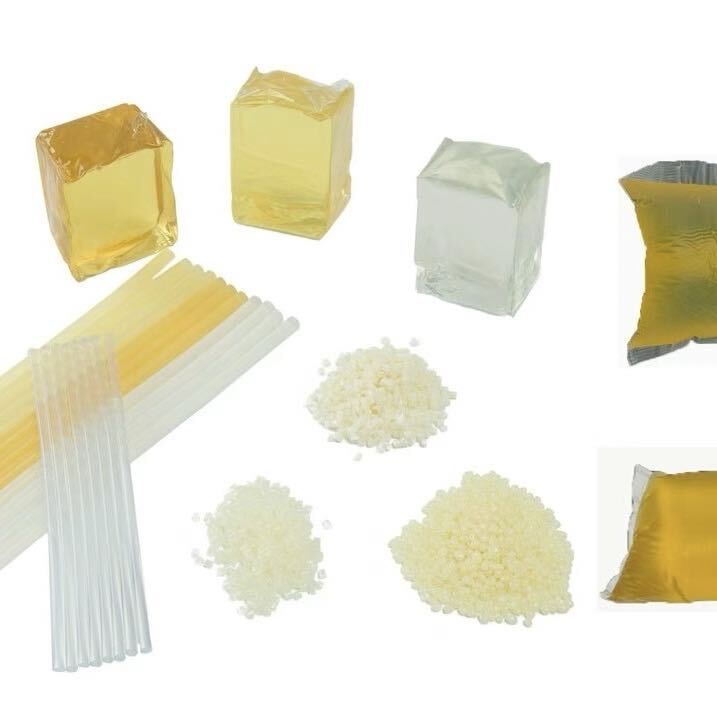
At Zhejiang Jiechuang New Materials Technology Co., Ltd., we understand that adhesive requirements vary with substrate construction, production equipment, and the expected behavior of the finished product. Our portfolio includes hot melt adhesive sticks, granules, pressure-sensitive adhesives, adhesive blocks, and PUR systems for different industrial applications.
Customers evaluating a hot melt adhesive sheet can start by defining the material combination and performance requirements. Sharing detailed application information helps establish a more useful direction for product evaluation.
- Material information: Identify the substrate types, surface finishes, thicknesses, and any coatings or treatments.
- Flexibility requirements: Describe the required bending behavior, stretch retention, compression recovery, or finished hand feel.
- Bonding requirements: Define the required adhesion performance and the conditions under which the joint will be used.
- Processing details: Provide the available heating equipment, pressing conditions, and production cycle.
- Finished-product expectations: Explain any restrictions on visible adhesive lines, total thickness, weight, or surface appearance.
These details help us understand whether the application calls for a thinner adhesive layer, a more flexible formulation, different processing conditions, or a combination of adjustments. The final recommendation should be confirmed through technical review and application testing.
Balance Thickness With the Flexibility the Product Needs
Hot melt adhesive sheet thickness can influence the flexibility of a bonded structure, but the relationship is not determined by thickness alone. Adhesive chemistry, substrate stiffness, layer arrangement, surface texture, and heat-pressing conditions all contribute to the final result.
A thinner sheet may help preserve the feel of lightweight materials, provided that it supplies adequate coverage and adhesion. A thicker sheet may accommodate certain surface irregularities, yet it can also change the bending behavior of the finished laminate. The appropriate specification depends on the balance between bond integrity and the movement required during use.
At Jiechuang, we recommend evaluating sheet thickness through controlled comparisons using actual production materials. Measuring both bond strength and flexibility provides a clearer basis for deciding whether a proposed adhesive configuration meets the application's requirements.