

 English
 中文简体
中文简体
Author: Jie Chuang
Date: Sep 04, 2026
Can Polyurethane Hot Glue Sticks Handle Flexible Materials
Flexible materials create a different challenge for adhesive bonding. A rigid bond may perform well while two surfaces remain still, yet the same bond can experience repeated stress once the material starts bending, stretching, folding, or vibrating. This is especially relevant to textiles, films, foam, synthetic leather, flexible plastics, and composite laminates.
Polyurethane hot glue sticks are often considered for these applications because polyurethane chemistry can provide a combination of adhesion, flexibility, toughness, and resistance to repeated movement. Reactive polyurethane hot melts also develop additional strength after the initial cooling stage through moisture curing. 3M describes PUR adhesives as flexible materials that can provide resistance to vibration and impact, with final structural strength developing after the initial hot-melt set.
But flexibility should not be treated as a universal property. Different polyurethane formulations can have very different hardness, elongation, viscosity, open time, and curing characteristics. The real question is therefore not simply whether PUR can bond flexible materials, but whether a particular formulation can tolerate the type and amount of movement required by the finished product.
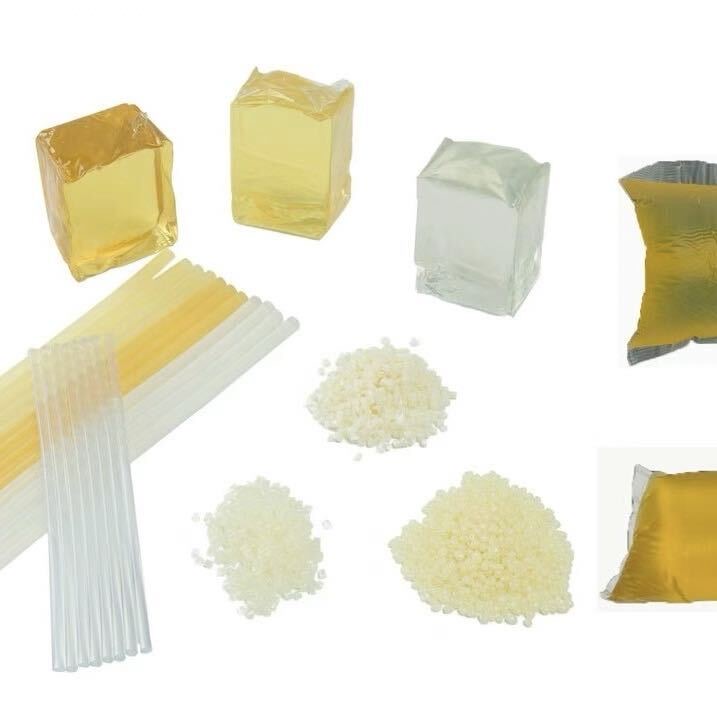
Why Flexible Materials Need a Different Bond Line
A flexible substrate can change shape while the adhesive layer remains attached to the opposing surface. This creates stress inside the bond line.
- Bending: repeatedly changes the angle between the bonded surfaces.
- Stretching: places tensile stress on the adhesive layer.
- Peeling: concentrates stress near the edge of the bonded area.
- Vibration: creates repeated small movements rather than one large deformation.
- Temperature changes: cause materials with different thermal expansion rates to move relative to each other.
A rigid adhesive may resist movement effectively at the beginning but can become vulnerable under repeated deformation. A tougher and more elastic adhesive layer can absorb part of this movement rather than transferring all of the stress directly to the substrate interface.
Polyurethane adhesives are widely used for durable and flexible adhesive bonds because their polymer structure can provide a balance between strength and deformation. Technical references describe moisture-cured polyurethane systems as capable of forming flexible bonds, with reported elongation-at-break ranges for reactive polyurethane hot melts extending into several hundred percent.
Elongation Is an Important Technical Parameter
Elongation at break indicates how far an adhesive specimen can stretch before failure during a tensile test. It does not directly predict the performance of every bonded assembly, but it gives useful information about the flexibility of the cured adhesive.
| Technical parameter | What it indicates | Why it matters for flexible bonding |
| Elongation at break | Ability to deform before rupture | Useful for evaluating stretching and movement |
| Modulus | Resistance to deformation | Helps indicate how soft or stiff the cured adhesive may feel |
| Tensile strength | Stress tolerated before failure | Relevant to load-bearing flexible assemblies |
| Peel strength | Resistance to separation from an edge | Important for films, fabrics, labels, and laminates |
| Open time | Available bonding window | Affects positioning of flexible or large-area materials |
| Final cure time | Time required for developed bond properties | Important for downstream testing and handling |
Commercial polyurethane formulations demonstrate how wide this performance range can be. One textile PUR series lists elongation-at-break values from approximately 480% to more than 700%, depending on the formulation. Another textile grade lists elongation above 700%.
These figures should not be interpreted as universal performance targets. They demonstrate that polyurethane adhesive chemistry can be formulated across a broad flexibility range.
Soft Does Not Automatically Mean Weak
A common concern is that an adhesive with high flexibility may sacrifice bonding strength. That relationship is more complicated than a simple strong-versus-soft comparison.
A flexible adhesive can maintain a relatively compliant bond line while still developing substantial cohesive strength after curing. The formulation has to balance hard and soft segments, molecular structure, crosslinking, and additives according to the intended application.
Some textile-oriented PUR products illustrate this approach. One commercial grade reports a tensile strength above 300 kgf/cm² together with elongation above 700%, while another fabric-oriented formulation combines a relatively low modulus with elongation in the 250–650% range.
This combination can be useful for applications where the adhesive needs to move with the substrate rather than acting as a rigid joint.
Strength and Flexibility Need to Be Evaluated Together
Consider a flexible film attached to a textile layer. The finished assembly may be bent hundreds or thousands of times. A high tensile-strength value alone does not tell you whether the adhesive will survive that repeated movement.
A better evaluation includes:
- Tensile strength
- Elongation
- Peel resistance
- Flex-fatigue performance
- Temperature resistance
- Moisture resistance
- Adhesion after repeated deformation
This broader testing approach gives a more realistic picture of a flexible adhesive system.
Which Flexible Materials Can PUR Hot Melt Bond?
Flexible bonding covers a surprisingly wide range of materials. A formulation suitable for fabric lamination may not necessarily be the right choice for silicone-like surfaces, low-surface-energy plastics, or highly elastic films.
| Material type | Typical bonding consideration | PUR suitability |
| Textile fabric | Flexibility, wash resistance, soft hand feel | Widely used in textile lamination |
| TPU film | Elasticity and film movement | Suitable formulations are available |
| Foam | Low-density structure and deformation | Requires compatible viscosity and application conditions |
| Synthetic leather | Repeated bending and surface finish | Formulation-dependent |
| Flexible PVC | Plasticizer compatibility | Requires substrate-specific testing |
| PE/PP foam | Low surface energy | May require surface treatment |
Henkel, for example, lists a highly flexible PUR formulation compatible with acetate, paper, and PVC, while noting that sensitive PE/PP foams can require corona pretreatment to increase surface energy above 40 dynes/cm.
This is an important reminder: adhesive flexibility cannot compensate for poor surface compatibility. A flexible adhesive still needs sufficient wetting and interfacial adhesion.
Textile and Film Lamination Are Good Examples
Textile lamination shows why polyurethane hot melt technology can be useful with flexible substrates. The adhesive must connect materials that may bend, stretch, wrinkle, and experience washing or thermal changes.
Several commercial PUR products are specifically designed for fabric, TPU film, waterproof fabric, and membrane lamination. One product series lists processing temperatures around 80–110°C and elongation-at-break values of 600–800%, depending on grade.
Another PUR product designed for fabric-to-fabric lamination specifies elongation values around 250–650% and describes the cured adhesive as very soft.
These characteristics can help maintain a softer bond line instead of creating a hard plastic-like layer between flexible materials.
Soft Hand Feel Can Matter
Some applications are not judged only by bond strength. Apparel, footwear components, upholstery, wearable products, and flexible consumer goods may also require the finished assembly to retain a natural feel.
A hard adhesive layer can become noticeable through a thin textile or film. A softer polyurethane formulation may reduce that effect while still providing sufficient bonding performance.
This is one reason technical data sheets sometimes mention properties such as “soft after curing,” “soft hand,” or “cold flexibility” rather than reporting strength values alone.
What Happens During Repeated Bending?
Repeated bending produces a fatigue problem rather than a single-load problem.
Imagine a flexible panel folded backward and forward. The adhesive layer experiences alternating compression and tension. Over time, weak interfaces, excessive stiffness, poor wetting, or internal defects can become initiation points for failure.
A flexible PUR formulation can accommodate some of this movement through elastic deformation. 3M notes that PUR adhesives can provide flexibility together with vibration and impact resistance, while Henkel describes certain PUR products as having good cold flexibility and resistance to temperature extremes.
However, the exact result depends on the adhesive grade and the substrate combination. A specification sheet should therefore be matched to the actual deformation conditions.
Temperature Changes Add Another Challenge
Flexible products may move considerably during temperature changes. Plastic films, textiles, foam, metal inserts, and composite layers can have different coefficients of thermal expansion.
Repeated heating and cooling can therefore create stress at the adhesive interface even when the finished product appears stationary.
- Low-temperature flexibility helps the bond remain compliant after cooling.
- High-temperature stability helps maintain bond integrity during heat exposure.
- Thermal shock resistance becomes relevant where temperature changes occur rapidly.
- Creep resistance matters under long-term stress at elevated temperatures.
One Henkel PUR product, for example, is specified for high heat resistance up to 150°C and cold flexibility, illustrating how a formulation can be engineered for a wide service-temperature range.
Open Time Matters With Flexible Substrates
Flexible materials often need careful alignment before pressure is applied. A very short open time can make this difficult, particularly with large films or fabrics.
Commercial products show considerable variation. One textile PUR adhesive reports an open time above five minutes, while another Henkel PUR formulation lists an open time of eight minutes.
A longer open time can give operators additional positioning freedom, but it also changes the production sequence. The appropriate value depends on equipment, substrate size, adhesive application method, and assembly speed.
Application Method Changes the Result
The same adhesive can behave differently depending on how it is applied.
- Roll coating can create a thin and relatively uniform adhesive layer.
- Slot coating can provide controlled adhesive placement.
- Nozzle application is useful for beads, narrow areas, and assembly lines.
- Manual glue guns may be appropriate for smaller-volume applications.
Film thickness also affects curing. Henkel notes that final curing time can depend on adhesive-film thickness, material permeability, atmospheric humidity, and moisture content.
Technical Example: Flexible PUR Performance
The following figures illustrate the type of information buyers may find on commercial polyurethane adhesive data sheets. They are examples rather than universal specifications.
| Property | Example Range | Application Relevance |
| Viscosity | About 5,000–20,000 mPa·s | Controls flow and coating behavior |
| Processing temperature | About 80–140°C | Depends on formulation and equipment |
| Open time | Several minutes in some grades | Provides positioning time |
| Elongation | Approximately 250–800% in some textile grades | Indicates deformation capability |
| Final cure | Typically develops over hours or days | Important for final performance |
Published product data confirms the broad range. Coating P. Materials lists textile PUR formulations with viscosities from roughly 5,000 to 20,000 mPa·s and elongation values ranging from around 250% to above 700%, depending on the grade.
Where Flexible PUR May Need Extra Attention
Not every flexible substrate is automatically easy to bond. Low-surface-energy plastics can present a significant adhesion challenge. PE and PP are notable examples because the adhesive may not wet or anchor to the surface sufficiently without pretreatment.
Surface treatment can change the bonding result substantially. Corona treatment, plasma treatment, primers, cleaning, or mechanical preparation may be used depending on the substrate and production process.
Storage also deserves attention with reactive polyurethane systems. Because moisture participates in the curing reaction, uncontrolled exposure before application can affect adhesive behavior. Proper moisture protection and equipment handling are therefore important parts of process control.
How Should Flexible Bonding Be Tested?
A tensile lap-shear test alone may not represent the real conditions of a flexible product. A better test program can reproduce the actual movements expected during service.
- Peel test: evaluates resistance to edge separation.
- Repeated bending test: checks performance after repeated flexing.
- Stretch test: measures behavior under controlled elongation.
- Thermal cycling: evaluates performance after repeated heating and cooling.
- Humidity exposure: checks the effect of moisture on the cured bond.
- Wash testing: can be important for textile and wearable applications.
Testing the actual substrate combination is equally important. An adhesive that performs well with TPU film and one textile may behave differently with PVC, PE foam, coated fabric, or another polymer film.
So, Can PUR Hot Glue Handle Flexible Materials?
Yes, appropriately formulated polyurethane hot melt adhesives can be well suited to flexible bonding. Their value comes from the ability to combine initial hot-melt handling strength with a cured adhesive layer that can remain flexible and accommodate movement.
Commercial PUR products demonstrate this through combinations of high elongation, soft cured characteristics, cold flexibility, and resistance to repeated environmental exposure. Textile and film lamination are established examples, while flexible plastics, foams, upholstery materials, and other assemblies can also be considered with substrate-specific testing.
The key is matching the adhesive's mechanical profile to the movement of the finished product. A flexible substrate may need an adhesive with high elongation and suitable peel resistance. A product exposed to large temperature swings may require additional thermal flexibility. A low-surface-energy film may require surface treatment before bonding.
Ultimately, polyurethane hot glue sticks can handle flexible materials, but the right formulation should be judged by more than its initial bond strength. Elongation, modulus, peel performance, open time, viscosity, curing behavior, substrate compatibility, and environmental resistance provide a more complete picture of whether a PUR hot melt adhesive is suitable for a particular flexible assembly.